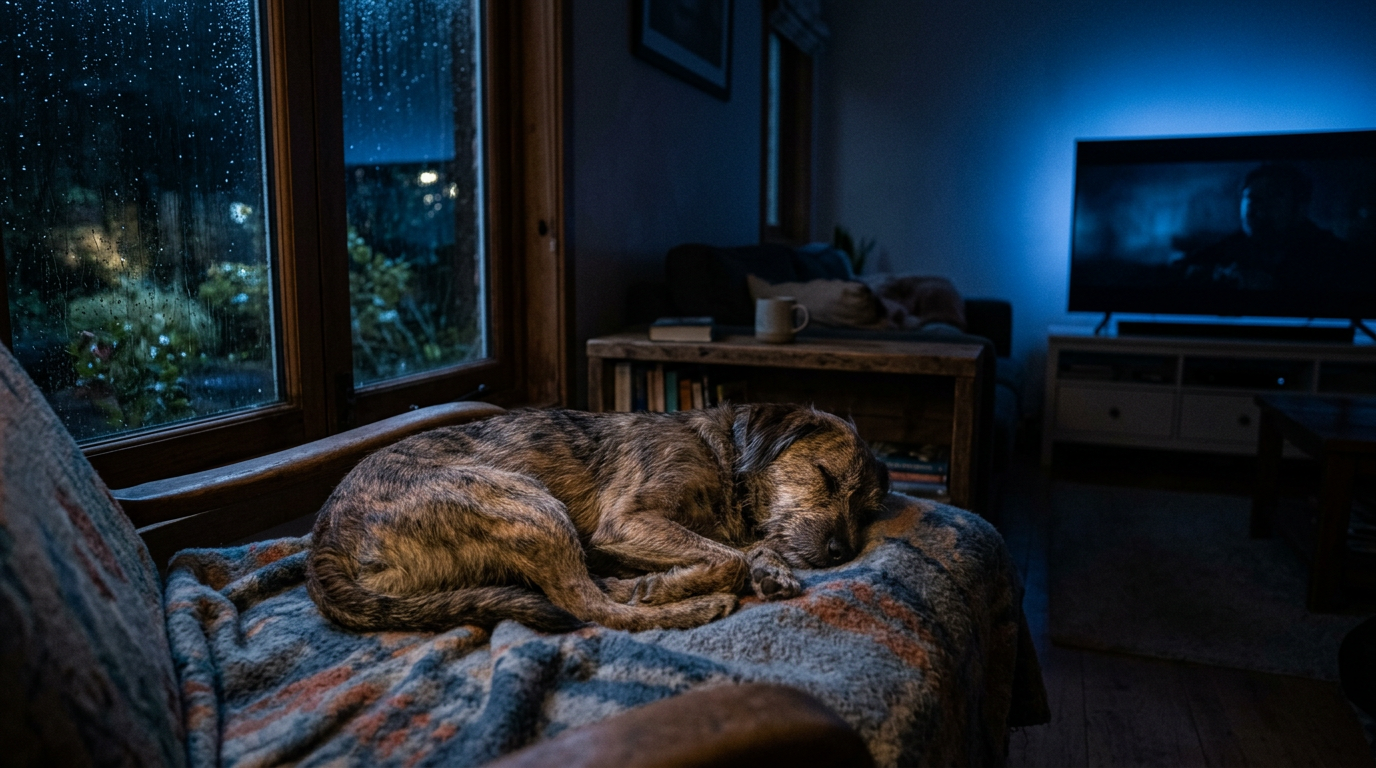
A dog asleep on a blanket in a dark room lit by a soft blue screen, with rain on the window

Quiet for loud nights.

Deep brown noise, rain and soft dog-visible light that reacts to each thunderclap. Plus a training mode to make storms less scary before the season starts.

Masking band
20–320 Hz
Dog-visible light
429 / 555 nm
Studies cited
29

Studio

Set it once. Let it run.

Choose a situation, press Start, then go full screen. Every slider shows a shaded band for where to start.

Standby

Dusk sky: Blue fading into amber, the two hues of a dog’s dichromatic world, like an evening horizon.

You see10%light outYour dog sees

Live check

What is your dog doing right now?

Tap what you see. The mix adjusts within safe limits for your dog's age.

Age

Hearing: Full hearing range, roughly 67 Hz to 45 kHz (Heffner, 1983). The presets are used unchanged.

Eyes: Standard light levels.

Why this mix

Thunderclaps peak around 100 to 220 Hz and rumbles run lower. Low-frequency noise also masks higher sounds well (the “upward spread of masking”), so a deep, bass-heavy noise covers both. For heavy storms, turn on Storm Guard below so the noise swells the moment a clap hits.

Sleep timer

Stress hormones stay high for 40+ minutes after a storm recording ends, so err long. The timer fades out over a full minute, because dogs bark more right after music stops abruptly.

Live telemetry

Every storm, counted.

Anonymous totals from everyone using Quiet Den. A session counts once it has run for at least a minute. After you stop, you can tell us how your dog did.

Hours of calm played9.3Across 21 sessions
Dogs calmed11Sessions where the owner reported calm or sleep
Storm sessions179 rated calm during thunder or fireworks
Calm rate79%Of 14 rated sessions
  • Calm or slept11
  • A little unsettled3
  • Still stressed0

Owner-reported, not a clinical measure. Dogs that stay stressed should see a vet.

What the research says

29 peer-reviewed studies on noise fear, sound, ageing hearing, dog vision and lighting. Each card links to the paper and explains what it changed in the studio above.

How common noise fear is

Why storms and fireworks deserve a plan.

Dreschel & Granger · 2005

Physiological and behavioral reactivity to stress in thunderstorm-phobic dogs and their caregivers(opens Google Scholar in a new tab)

Applied Animal Behaviour Science

In 19 storm-phobic dogs at home, a 5-minute thunderstorm recording raised saliva cortisol by 207%, and levels had not returned to baseline 40 minutes later.

How this shaped the app

One clap keeps stress high for a long time, so each new clap lands on an already stressed dog. Storm Guard aims to soften every clap, and the sleep timer runs long enough to cover recovery.

Riemer · 2020

Effectiveness of treatments for firework fears in dogs(opens Google Scholar in a new tab)

Journal of Veterinary Behavior

In a survey of 1,225 owners, counterconditioning (giving food or play right after a noise) was among the most effective strategies, and it worked even when done informally rather than as a formal training plan.

How this shaped the app

Storm Guard can show a “Treat now” reminder the moment it hears a bang, so the good thing arrives right after the scary one.

Blackwell, Bradshaw & Casey · 2013

Fear responses to noises in domestic dogs: prevalence, risk factors and co-occurrence with other fear related behaviour(opens Google Scholar in a new tab)

Applied Animal Behaviour Science

In a UK owner survey, about 49% of dogs showed at least one behavioural sign of fear to loud noises, with fireworks the most common trigger. Fewer than a third of owners had sought professional help.

How this shaped the app

Noise fear is common and under-treated, so the app includes a storm-night plan and points to vets for severe cases.

Training and treatment

What changes noise fear for good, behind Practice mode and the live check.

Levine, Ramos & Mills · 2007

A prospective study of two self-help CD based desensitization and counter-conditioning programmes with the use of Dog Appeasing Pheromone for the treatment of firework fears in dogs(opens Google Scholar in a new tab)

Applied Animal Behaviour Science

Owners who played recorded firework sounds at gradually rising volume, paired with good things, saw significant drops in fear severity at follow-up. The main obstacle was owners not finding time to practise.

How this shaped the app

Practice mode is a built-in version of this programme: ten graded levels of soft synthetic thunder, a treat cue on every rep and short 10-minute sessions so it fits into a normal day.

Sherman & Mills · 2008

Canine anxieties and phobias: an update on separation anxiety and noise aversions(opens Google Scholar in a new tab)

Veterinary Clinics of North America: Small Animal Practice

The review sets out the standard for noise aversion: graded exposure kept below the level that causes fear, combined with counterconditioning, plus a safe place and situational medication when needed.

How this shaped the app

Practice mode steps back two levels after any reaction and asks you to end on a relaxed rep, so exposure always stays below your dog’s fear threshold.

Korpivaara, Laapas, Huhtinen & Schöning · 2017

Dexmedetomidine oromucosal gel for noise-associated acute anxiety and fear in dogs: a randomised, double-blind, placebo-controlled clinical study(opens Google Scholar in a new tab)

Veterinary Record

In a New Year’s Eve fireworks trial, 72% of owners rated the treatment effect as good or excellent, versus 37% with placebo.

How this shaped the app

If the live check shows panic, the app says plainly that sound alone isn’t enough and points you to your vet, because medicines like this have trial evidence.

Engel, Müller, Klee, Francke & Mills · 2019

Effectiveness of imepitoin for the control of anxiety and fear associated with noise phobia in dogs(opens Google Scholar in a new tab)

Journal of Veterinary Internal Medicine

In a placebo-controlled trial during a fireworks period, dogs on imepitoin showed significantly lower owner-rated anxiety than dogs on placebo.

How this shaped the app

Another reason the live check escalates to a vet for trembling or panic every storm. The app is a support tool, not a replacement for treatment.

Sound and stress

What controlled studies found when dogs were played different sounds.

Bowman, Scottish SPCA, Dowell & Evans · 2015

‘Four Seasons’ in an animal rescue centre; classical music reduces environmental stress in kennelled dogs(opens Google Scholar in a new tab)

Physiology & Behavior

Classical music improved heart-rate variability, a physiological marker of lower stress, but the benefit faded within about a week as dogs habituated.

How this shaped the app

Save the strong storm presets for real storms, and change settings over time instead of playing one identical track every day.

Alvarsson, Wiens & Nilsson · 2010

Stress recovery during exposure to nature sound and environmental noise(opens Google Scholar in a new tab)

International Journal of Environmental Research and Public Health

After a stressful task, people’s skin-conductance stress response recovered faster while hearing nature sounds than while hearing road or ambient noise at similar loudness. This is a human study.

How this shaped the app

The rain layer adds a soft natural texture to the brown noise. It is also the one kind of sound that can blend with a real storm outside instead of competing with it.

Bernardi, Porta & Sleight · 2006

Cardiovascular, cerebrovascular, and respiratory changes induced by different types of music in musicians and non-musicians: the importance of silence(opens Google Scholar in a new tab)

Heart

Faster tempo raised breathing rate and blood pressure in listeners; slow tempo and pauses lowered them, with the calmest readings during pauses. This is a human study.

How this shaped the app

Tempo and swell pace stay slow, the tone layer leaves long gaps, and the settle-down glide ends at your slow settings rather than staying fast.

Heiderscheit & Madson · 2015

Use of the iso principle as a central method in mood management: a music psychotherapy clinical case study(opens Google Scholar in a new tab)

Music Therapy Perspectives

Describes the iso principle used in music therapy: start near the listener’s current arousal, then change tempo and intensity gradually toward the target state.

How this shaped the app

The settle-down glide starts the swells and tones a little faster and eases them down over minutes. The principle comes from human therapy; it has not been tested in dogs.

The physics of covering a thunderclap

Why the app masks and swells instead of trying to cancel thunder.

Egan & Hake · 1950

On the masking pattern of a simple auditory stimulus(opens Google Scholar in a new tab)

Journal of the Acoustical Society of America

A low-pitched masking sound hides higher-pitched sounds much more than the reverse, and this “upward spread of masking” grows as the masker gets louder. It comes from the mechanics of the inner ear, which mammals share.

How this shaped the app

This is why deep brown noise is the base layer: it covers the thunderclap band and spills upward. The Crackle cover layer handles the high firework band that deep noise can’t reach.

Holmes, Brook, Krehbiel & McCrory · 1971

On the power spectrum and mechanism of thunder(opens Google Scholar in a new tab)

Journal of Geophysical Research

Recorded thunder carries most of its audible power in the low hundreds of hertz and below, with rumbles and infrasound lower still. Much of that energy sits below what small speakers can play.

How this shaped the app

The “Sound comes from” setting matches the bass to your speaker. A phone can’t produce thunder-band sound, so the app shifts energy upward instead of wasting loudness on distortion.

Kuo & Morgan · 1999

Active noise control: a tutorial review(opens Google Scholar in a new tab)

Proceedings of the IEEE

Active noise cancellation only works in a small zone near the error microphone, like inside headphones. In an open room, anti-noise adds to the sound in some spots while cancelling it in others.

How this shaped the app

True cancellation of thunder from a TV or phone isn’t physically possible. So the app uses adaptive masking instead: it raises steady noise the instant a bang is heard, which lowers the contrast between quiet and loud.

How hearing changes with age

The data behind the puppy, senior and geriatric profiles.

ter Haar, Venker-van Haagen, van den Brom, van Sluijs & Smoorenburg · 2008

Effects of aging on brainstem responses to toneburst auditory stimuli: a cross-sectional and longitudinal study in dogs(opens Google Scholar in a new tab)

Journal of Veterinary Internal Medicine

Brainstem hearing tests showed age-related hearing loss starting at about 8 to 10 years. It affected all frequencies but was largest and progressed fastest in the middle-to-high range (8 to 32 kHz).

How this shaped the app

Senior and geriatric profiles shift the mix toward low frequencies they still hear, with only a small volume lift and a firm cap.

Strain, Tedford & Jackson · 1991

Postnatal development of the brain stem auditory-evoked potential in dogs(opens Google Scholar in a new tab)

American Journal of Veterinary Research

Puppies’ ear canals open at about 2 weeks, and hearing thresholds reach adult levels at about 20 days, although brainstem pathways keep maturing for several more weeks.

How this shaped the app

Puppies get no volume boost. Their profile is quieter, with a lower cap and a longer fade-in, because they are still learning which sounds are safe.

Lopes Fagundes, Hewison, McPeake, Zulch & Mills · 2018

Noise sensitivities in dogs: an exploration of signs in dogs with and without musculoskeletal pain using qualitative content analysis(opens Google Scholar in a new tab)

Frontiers in Veterinary Science

Dogs with musculoskeletal pain developed noise sensitivity much later, at about 6.5 years, than dogs without pain, at about 2.7 years. The researchers suggest pain may worsen the tension caused by startling.

How this shaped the app

Senior and geriatric profiles show a prompt to get new noise fear checked by a vet.

What dogs see on a screen

The vision science behind the colour palettes.

Neitz, Geist & Jacobs · 1989

Color vision in the dog(opens Google Scholar in a new tab)

Visual Neuroscience

Dogs are dichromats, with two cone types peaking near 429 nm (blue-violet) and 555 nm (yellow-green). Reds and greens look like dull, similar tones to them.

How this shaped the app

All palettes are built from blues and yellow-ambers, the colours a dog can actually tell apart. No reds or greens.

Jacobs, Deegan, Crognale & Fenwick · 1993

Photopigments of dogs and foxes and their implications for canid vision(opens Google Scholar in a new tab)

Visual Neuroscience

Dog cones peak near 429 nm (blue-violet) and 555 nm (yellow-green), and rods near 506 to 510 nm. Dogs cannot tell red from green and are very insensitive to deep red.

How this shaped the app

In a dark room rods do much of the work, so blues and teals look brighter and reds darker to a dog than to you. The dog-eye brightness balance adjusts for this.

Light in a dark room

Why the screen stays dim, steady and flicker-free when it is the only light.

Miller & Murphy · 1995

Vision in dogs(opens Google Scholar in a new tab)

Journal of the American Veterinary Medical Association

Dog retinas are rod-dominated, with rod pigment peaking near 506 to 510 nm, and a reflective tapetum lucidum that gives light a second pass. Dogs see well in dim light and are highly sensitive to motion.

How this shaped the app

The dark-room mode halves output, and the TV setting halves it again, because what looks dim to you is much brighter to your dog. Smooth gradients avoid moving shapes.

Abrams, Wilson, Hegewald, Braun & Byosiere · 2025

Behavioral differences of shelter dogs under fluorescent versus LED lighting(opens Google Scholar in a new tab)

Applied Animal Behaviour Science

Shelter dogs under fluorescent lighting stood and barked more. Under flicker-free LED lighting they were more likely to lie down and stay at the back of the kennel.

How this shaped the app

The app recommends mid hardware brightness with software dimming, since some screens flicker (PWM) at low hardware brightness.

What isn't proven yet

These are the limits of the evidence, stated plainly.

  • The settle-down glide, rain layer and dusk dim-down are based on human studies and on dog vision and hearing science. None has been tested as a calming method in dogs. The dog-eye brightness balance uses an approximate rod/cone mix, not a measured dog luminance curve.
  • We couldn’t find a peer-reviewed trial that tests brown noise on its own in dogs. Using it here is based on masking acoustics and on studies of calm, steady sound, not on proof that it works.
  • No controlled study has shown that screen colours alone lower stress in dogs. The palettes are designed around what dogs can see, not what has been shown to calm them.
  • The age profiles are built from hearing-loss and vision data, not tested as a calming treatment. Treat them as sensible starting points and adjust for your own dog.
  • Claims that blue light lowers cortisol or heart rate in dogs are widely repeated online, but we couldn’t find a primary study to support them, so the app doesn’t make that claim.
  • Dogs, like other mammals, have blue-sensitive melanopsin cells and make more melatonin at night. The Night warmth setting draws on this general biology, but no dog trial has tested warm screen light for sleep during storms.
  • Storm Guard’s reactive swell is built on masking acoustics and the clustered timing of storm claps. No dog trial has tested reactive masking specifically.
  • Masking can’t hide a close thunderclap or a firework bang. The goal is to lower the contrast between quiet and loud so each bang is less startling.
  • Severe noise phobia is a medical and behavioural condition. Ask a veterinarian or veterinary behaviourist about desensitisation plans and medication.

A storm-night plan

Sound and light help most as part of a routine. These steps follow standard veterinary behaviour advice for dogs who are afraid of noise.

  1. Step 1

    Days before: make it familiar

    Play the Everyday rest preset during calm meals and naps. That way the sound means “safe and normal”, not “something scary is coming”.

  2. Step 2

    An hour before: start early

    Check the forecast or the fireworks schedule. Start the sound with a long fade-in before the first bang, while your dog is still relaxed.

  3. Step 3

    Build a den

    Set up a crate or corner with a blanket over it, away from windows. Draw the curtains and put the screen where it glows softly toward the den.

  4. Step 4

    Let them choose

    Never force your dog into the den or hold them in place. Comfort them if they come to you. Reassuring a scared dog does not reward fear.

  5. Step 5

    Watch the body language

    Panting, pacing, trembling, lip-licking and hiding are stress signs. If they get worse, lower the volume or switch the sound off.

  6. Step 6

    Talk to your vet

    If your dog panics, gets hurt or tries to escape, ask about desensitisation training and short-term medication before the next season.